

If you're looking at solar, solar panels, a solar inverter, a battery, or an EV charger, there's one question every installer will ask within the first five minutes: "Is your home single phase or three phase?"
It sounds technical, but the answer changes what you can install, how big a system you can run, and how much power you can export back to the grid. So here's what it means and why it matters.
What's the difference between single phase and three phase power?
When we talk about "phases," we're really talking about how electrical power is delivered to your home.
Single phase sends power down one active wire (plus a neutral). It's the most common setup in older Aussie homes.
Three phase sends power down three active wires (plus a neutral). It's increasingly common in newer builds and homes that have been upgraded.
The reason three phase exists comes down to load. The more electricity-hungry stuff in a home, the more power needs to flow at any one moment. With three phase, the household load is split across three wires instead of one, which means more total power can flow without overloading the system.
Historically, most Aussie homes were built single phase because the load was modest: lights, a fridge, a TV, maybe an electric stove. These days, most homes are running a whole lot more power at any given time. Three phase handles all of that more comfortably.
How to tell if you have single or three phase
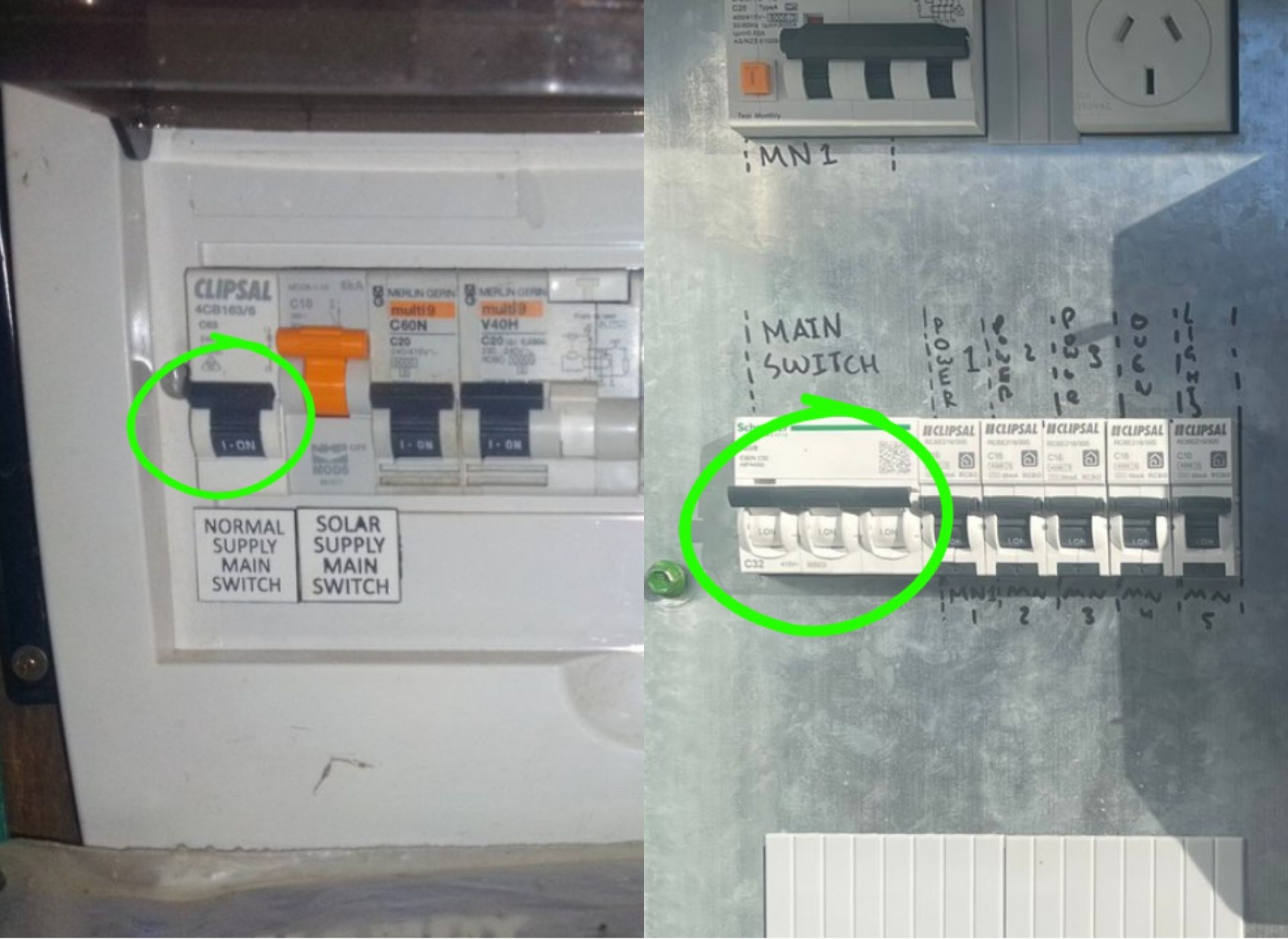
Easiest way: go and have a look at your meter box.
If you see one main switch or one fuse cartridge, you have a single phase connection.
If you see three main switches or three fuse cartridges side by side, you have three phase power.
You can also check your electricity meter itself. A three phase meter often has "3P 4W" or similar written on it. A single phase meter doesn't.
Still not sure? Take a photo of your meter box with the lid open and send it to us. We can tell you what you've got pretty much instantly.
How does phase affect solar installations?
Your phase determines a few key things about what solar system you can install.
Inverter size. A single phase home runs on a single phase inverter. A three phase home can run either a single phase or three phase inverter (though three phase is usually the better fit for bigger systems).
Maximum panel size. Single phase homes are capped at a smaller inverter, which limits how much solar can run through to the grid at once. Three phase homes can run bigger inverters and therefore bigger panel arrays without export limiting.
Export limits. This is where it gets specific to your network. Distribution Network Service Providers (DNSPs) set rules on how much power your system can export back to the grid. These caps are per phase, so a three phase home can usually export three times as much as a single phase one.
The good news: export limiting only affects how much you can send back to the grid, not how much your solar system can generate for your own use. So even on a single phase home with a 5 kW export cap, you can still install a much bigger system and use the energy yourself (or store it in a battery).
How does phase affect batteries?
Phase can also affect which battery and inverter set-up will be right for your home.
Modular battery systems (like the Sungrow SBH and GoodWe ESA) use the same battery modules regardless of phase. The hybrid inverter you pair them with is what makes the system single phase or three phase.
Integrated battery systems (like the Tesla Powerwall 3) come with the inverter built in. The Powerwall 3 is single phase only in Australia, though it can still be installed on a three phase home where it operates on one phase.
Backup capabilities also come down to the inverter and how your installer configures the system. A single phase battery on a three phase home will only back up the circuits on the phase it's connected to. For backup across all three phases during a blackout, you'll generally need a three phase battery inverter.
How does phase affect EV charging?
This one's increasingly important.
- Single phase EV chargers typically max out at around 7 kW of charging speed
- Three phase EV chargers can deliver up to 22 kW (depending on your distributor's rules and the car's onboard charger)
For most homes, 7 kW is plenty. A standard EV charges from empty to full overnight on a 7 kW charger. But if you've got two EVs, drive long distances, or want the fastest possible home charging, three phase is the upgrade path.
Should I upgrade to three phase power?
A three phase upgrade is possible but can cost you quite a bit, depending on your home's wiring and how far you are from the street connection.
Whether it's worth the spend depends on:
- Your electricity usage. Big users, all-electric homes, and homes with multiple EVs benefit most.
- Your solar plans. If you want a system bigger than about 8 kW with no export limiting, three phase is the way.
- Your network area. If you're on a network that allows 10 kW per phase, you've got more room to move on single phase than someone on a 5 kW per phase network.
- Your future plans. If you're heading toward a battery, an EV, and a heat pump, three phase tends to pay off in the long run.
For most homes, an upgrade isn't strictly necessary. A well-designed single phase system can still cover the needs of a typical Aussie household for years. But it's worth running the numbers if you're planning a big shift toward electrification.
What we'd recommend
Don't let the single vs three phase question stress you out. The vast majority of Aussie homes are single phase, and the vast majority of those will run a perfectly good solar and battery setup without ever needing to upgrade.
We can work with what you've got and design the right system for your phase and your network area. And if you're not sure about whether your home is single phase or three phase? That's no problem at all. We're happy to walk you through it. Request a free quote to get started.
Frequently asked questions
The easiest way is to check your meter box. Open it up and count the main switches or fuse cartridges. If you see three, you have three phase power. If you only see one, you have a single phase connection. If you're still unsure, take a photo of your meter box with the lid open and send it to us, and we'll confirm it for you.
Yes, you can. A three phase home can have either a three phase or a single phase inverter installed, so you have flexibility in your options. However, if your home only has a single phase connection, you can only install a single phase inverter. A good solar retailer will always recommend the appropriate option based on your home's setup.
Yes. Your distributor sets a cap on how much power you can export per phase, so a three phase connection generally allows you to export more in total. Limits vary by distributor. For example, Ausgrid allows up to 10kW per phase, while many other distributors only allow 5kW per phase. In a typical residential setup though, this is rarely a dealbreaker.